Let us begin
with a simple question: Have you ever wonder what makes up the world we are
living in today? Of course, apart from the obvious air, water, earth and all
that is in between, a questioning psyche like the ancient Greeks to the
philosophical cosmos certainly opens up to infinity of ponderings and
never-getting-arounds.

Much like the
issue of what constitute to the post-Cold War and intellectuals have not
hesitated to propagate visions of what could be the end of history.

Alright, back to business for now.
The end of the
Cold War era has contributed to a large extent to the social political make-up
of modern society modern society today in terms of the social political make-up
as well as the formation of contemporary communal paradigms.
“It
is my hypothesis that the fundamental source of conflict in this new world will
not be primarily ideological or primarily economic. The great divisions among
humankind and the dominating source of conflict will be cultural… the principal
conflicts of global politics will occur between nations and groups of different
civilizations. The clash of civilizations will dominate global politics. The
fault lines between civilizations will be the battle lines of the future.”
And so begins
one of the most prominent, debated, and commented upon essay written in the
twentieth century which has since acted as a theoretical framework with which
to construe almost all of the conflicts that have broken out since the end of
the century while forecasting the manifestation of future conflicts. Samuel
Huntington, among the greatest American political scientist, in his phenomenal
‘The Clash of Civilizations?’ argued that the post-cold war would be marked by
civilizational conflict in the coming decade, the world could be divided not
along political lines but cultural lines. Culture, especially its religious,
has become the main cause of conflicts, far more than political objectives such
as territorial conquests.
Inevitably,
there seemed to be an obsession about this debate after laying out his theory
about the clash in Foreign Affairs’ article back in 1993. Subsequently,
an renewed obsession found its way onto this matter after Huntington refined
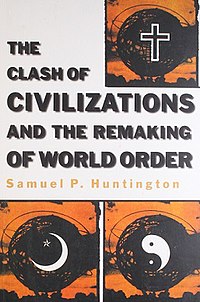
his theory in 1996 with a book entitled The Clash of Civilization and the
Remaking of World Order, primarily pinpointing the supposed ‘conflicts’
between the Islam nations and the non-Islamic West. In terms of communications,
there is without a doubt, a strong gravitation towards such news coverage
involving religion and all its related elements. This then constitutes to the
way the world is being covered through a molded perspective.
According to Cooper and Yue (2008), the post-Cold War era has presented to us many facets of uncertainty as to how the new world order is being shaped. Be it policymakers or the media, the geopolitical scheme after the tearing down of the Berlin Wall or the disintegration of Soviet Union remained rather ambiguous at that point of time. More so, the journalistic field had been pushed to new heights, in search of new ways in approaching international news coverage. However, it was not until Huntington’s essay which so happened to be produced during the milieu, which conveniently served as a tipping point for media makers to blow political matters out of proportions at many times. Especially when Islam comes into the picture, it is inevitable that Huntington’s claims of an imagined singularity and civilizational clash harnessed even more attention and to a certain extent, validation after the tragic September 11th incident which took place almost twelve years ago. The Muslims and the radical Islam were then portrayed by the mainstream American media as a dangerous foe to the world and certainly, to the West (Hickey, 2002). Newspaper headlines like “This is A Religious War” and “Muslim Rage” (Abrahamian, 2002) were most definitely a common sight at that moment and Islam was unfortunately being put into a bad light, just like how Huntington may very well be reducing the cause of this incident to the clash of Islam’s tectonic plate of the religion with “bloody borders”.

Nevertheless,
such reductionist view is typically combined with a rather ambiguous insight
into world history that seems to overlook, first, that the notion of ‘clash’
are between civilizational categories when the main clashes actually happened
within the civilizations. Secondly, Huntington failed to realize that there are
much more to the dynamics of such conflicts and it does not just stop at
cultural difference. In fact, Senghaas (2001) considers that many cultural
clashes contain economic roots.

Also, Huntington
blatantly accused Islam as having “bloody borders” when he emphasized “in the
1990s they [Muslims] have been far more involved in intergroup violence than
the people of any other civilization.” Conversely, empirical data indicated
Islam was only involved in 23.2 percent of all inter-civilizational conflicts
between 1945 and 1989, and 24.7 percent between 1990 and 1998. These shares are
not too far-off above Islam’s share in world population and the rise of this
form of involvement since the end of the Cold War is not that significant after
all (Fox, 2001). Once again, a flaw surfaced as Huntington generalized the
association of Muslims in ‘contributing’ to violence aggression when the
coverage of the Islamic borders comprise not just the neighboring countries in
which M. Shahid Alam , Professor of Economics at Northeastern University
responded “In any case, we have to be careful when we talk about “bloody
borders.”
Here is an
excellent article on the elaborated version of what we are talking about now.
Perhaps, with
such a technological determinist society that we are in today, the effects of a
widespread debate like this is hard to contain when accessing information is
just a click away. Perhaps, there could never be an end point to this debate on
what could be the main instigation of future social or civilizational fault
lines but here lies an inherent hope of mine: that with this analysis,
policymakers and the ruling authorities should consider a set of policies that
are more sound, sensible, objective and plausible as well as coverage for the
citizens to have a better idea of what the world is coming to.

______________________________________________________________________________
References
Abrahamian, E. (2002). The U.S. Media, Samuel
Huntington, and September 11. Middle East Report,
223, 62
Alam, M. S.
(2002, February 28). Huntington. Petrolia, California, United States of
America.
Cooper, W. W., & Yue, P. (2008). Challenges Of The
Muslim World: Present, Future and Past. Amsterdam:
Elsevier.
Fox, J. (2001).
Two Civilizations and Ethnic Conflict: Islam and the West. Journal of Peace Research, 38(4) , 459-472.
Hickey, N. (2002). Perspectives on War. Columbia Journalism Review, 40(6), 40
Huntington, S.
P. (1993a). The Clash of Civilizations? Foreign Affairs, 72(3) , 22-49.
Seib, P. (2004).
Strategic Studies Institute. Retrieved August 4, 2013, from The News
Media and the “Clash of Civilizations”: http://strategicstudiesinstitute.army.mil/pubs/parameters/Articles/04winter/seib.pdf
Senghaas, D.
(2001). The Clash within Civilisations: Coming to Terms with Cultural
Conflicts. London/New York:
Routledge.

I agree that Huntington has a rather reductionist view. Personally, I find Huntington's usage of the term 'Confucian' to represent China and other Chinese dominated nations is rather questionable I t's true that Confucian values had very strong followings however, that is no longer the case in contemporary China. In fact, according to this article here (http://journal.acs-cam.org.uk/data/archive/2010/201002-article11.pdf) Confucianism is viewed as a negative force and "an obstacle towards national development" as this out of fashion ideology promotes Feudalism. This shows that Huntington's knowledge on Asia is limited and can be very misleading.
ReplyDeleteIt's true that his view seems to be rather limited, though it's interesting part of China's 'soft power' seems to be to promote a version of Confucianism as representing China. However, as the Economist suggests, it seems to be more of an adapted version of Confcuianism that suits the current powers there:
ReplyDelete"Promoting Confucianism is not part of their remit. Party officials use Confucius as a Father-Christmas-like symbol of avuncular Chineseness rather than as the proponent of a philosophical outlook." (http://www.economist.com/node/17969895)
This underlies the point that cultures are always dynamic, and apparently stable markers such as religion, cultural icons, etc. are also always changing, though whoever promotes them simultaneously tends to claim they are advocating an 'authentic' version.
Thanks for this, I have sent you your evaluation.
ReplyDelete